“What one loves in childhood stays in their heart forever.” — Mary Jo Putney
Whenever I read Ruskin Bond’s books, I feel a surge of enthusiasm to express my thoughts. His simple writing style, especially while describing sunsets and everyday occurrences, makes his work magical and interesting. Bond prefers writing with a pen and has never used email. During my research, I tried to find his email address, but eventually received his home address from Rupa Publications. I wrote a lengthy, handwritten letter using a gel pen to inform him about my research. Bond’s love to write with an ink pen hurled me back into my childhood.
As a child, I wrote with an ink pen. Although we had ballpoint pens, the school teachers insisted that we use ink pens. These ink pens in those days were thick; they were designed with a large hollow space to hold lots of ink. I kept mine in a Camlin pencil box, which was the most popular instrument box back then. Later on, other brands emerged, introducing attractive geometry sets. These boxes were frequently used, much like modern pouches. They remained handy even after we lost many of the instruments, such as the protractor and compass. While the compass and divider were dangerous, a few students have used them for digging the soil in search of earthworms or poking others. The students in general were not aggressive then; they were calmer and friendlier. Over time, ink pens were introduced with a plastic chamber to hold ink; this was fitted with braces, which prevented the pen from leaking. These pens were excellent, but sharing ink with a classmate was a bit difficult.
The geometry box would fade and lose its orange design when jostled around inside our bags. Our school bags were made of denim. New school bags were rarely purchased. I used an old, faithful denim bag with a large flap that exposed a space for numerous books. Despite being lined up in two rows, the books sometimes got mixed up. This bag was passed down from my sister; its canvas had faded and softened from years of use and travel. My mother, with her gentle hands, would meticulously clean it, wiping away the dust of seasons gone by. It was the same with textbooks; my sister’s books found a new life with me each year, until they were quite ruined, and my Mother finally felt like purchasing a few bright new ones for me.
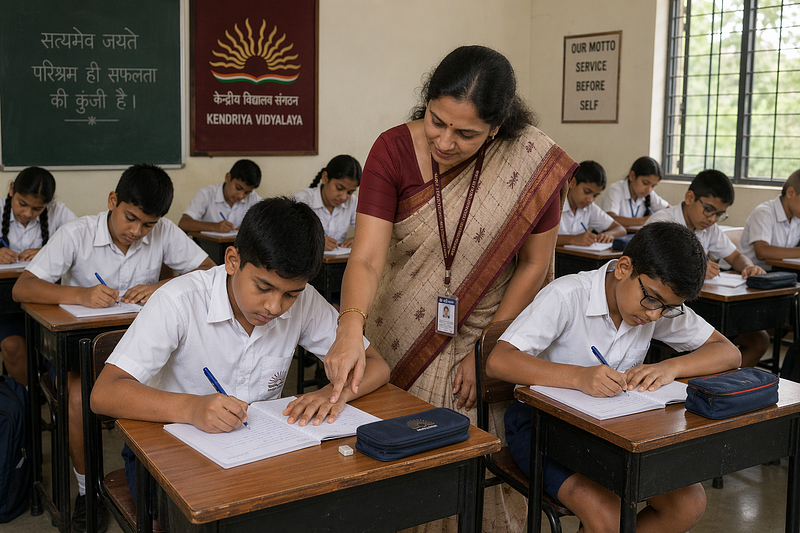
We either had to buy the books from the school bookstore or take the bus to Koti, a far-off book depot for the textbooks. Unfortunately, the books — especially the NCERT ones — were rarely in stock. The bookstore at the Kendriya Vidyalaya, where we studied, was a small room filled with numerous textbooks. It was cramped with books, and waiting in line had become a familiar part of our lives. We learned to form queues everywhere — at the ration shop, the vegetable vendor, for the school bus, or even at the milk shop. But the queue at the bookstore felt different. It was a time for laughter and stories, a chance to catch up with friends while we waited. A young salesman, with a warm smile, managed the bookstore. He would sometimes lose his temper.
Once we finally had the new books in our hands, our next task was to cover them. We had two kinds of brown paper to choose from: one was shiny and robust, which promised to endure the year, while the other was simpler and more fragile, ready to tear at the slightest touch. Along with the brown paper, we picked up some label strips to mark our books and carry our names. This little ritual felt like an adventure in itself, a delightful one, taking us closer to the school year. The air at home was filled with the scent of fresh brown paper, and with each fold and crease, there was the promise of new stories to be written.
The first few days of school were exciting, and we drew the index page carefully and wrote every bit neatly in our notebooks, assuring to do our best that academic year. However, within a few weeks, all those promises were forgotten. We faced punishments just the same, and our books began to look worn, with their pages opened numerous times. Those 200-page books never seemed to be enough for all the notes we took.
My mother, who loved reading our textbooks once we completed our work, would glance at my notes wistfully and often say, “You could write more neatly.” When I started a new notebook, she reminded me, “Mahatma Gandhi says our handwriting is a reflection of our character; yours seems to get worse each year.” I replied, “He would never have said that if he had to complete the notes like us!”
One day, despite all my lethargy for writing, I decided to make an effort to write neatly. For the next few days, I followed this promise diligently, and all my friends exclaimed, “We can’t believe how beautiful your handwriting is’. I smiled and explained how my mother encouraged me, but sadly, my neatness didn’t last long, and I soon returned to my old habits.
The CBSE board inspections were stressful for our teachers and us. We had to write everything neatly, and getting our work corrected was even worse, as it often resulted in us being scolded harshly. We had a bright set of students who were assigned to take care of a group of slow learners. These group leaders became overly anxious and would report our names to the teachers. They would check our books even more carefully than the teachers did.
In the classroom, our teachers punished us for mistakes by making us squat on the ground while completing our work. There were rare occasions when we were allowed to step out of the classroom, and if we were quick, we would wander off. However, a student who remained inside the class would usually report our absence to the teacher out of envy.
Today, I look at those memories as the most precious ones; there was something comforting in the experience. Even amidst the stress of inspections and corrections, the laughter and camaraderie we shared made every moment worthwhile. In the end, whether our handwriting was neat or messy, it was the love for learning and the joy of being together that truly mattered.
“Don’t you wish you could take a single childhood memory and blow it up into a bubble and live inside it forever?” — Sarah Addison Allen, “Lost Lake”
Comments
Post a Comment