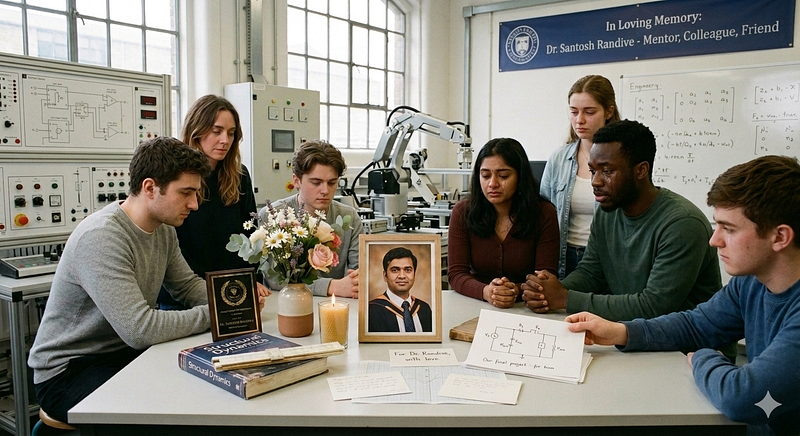
Everyone must leave something behind when he dies, my grandfather said. A child or a book or a painting or a house or a wall built or a pair of shoes made. Or a garden planted. Something your hand touched some way, so your soul has somewhere to go when you die, and when people look at that tree or that flower you planted, you’re there-― Ray Bradbury
These thoughts filled my mind as I remembered the people I’ve met along the way, each leaving a lasting impression on me. One face stood out warmly; it was of Santosh Sir.
My first encounter with Santosh Sir was nearly a decade ago when I was assigned a cabin in the training and placement cell at the college. It was actually an interview cabin, and there were five identical cabins. When given a choice, I selected the corner cabin with windows all around. I often stood there, admiring nature’s beauty in those days. Now we do not have any nature left.
One morning, Santosh Sir, a vibrant young faculty member from the Electronics and Telecommunication department, visited me. He sought my assistance with his research, which was related to technology and health; he specifically required guidance with formatting and grammatical errors. In those days, we did not have the luxury of AI to ease our load. For three consecutive days, he visited me faithfully, and together we polished his prose, reframing old sentences and breathing life into new ones. He would arrive with his writing pad, recording every suggestion with diligent care. Although I suggested he type these changes directly, he preferred this traditional method, later emailing the digital versions for my final scrutiny. Eventually, his research paper was successfully published, marking a significant milestone as he continued his scholarly pursuit towards a PhD.
We would often meet when I went to the 4th floor to print or to meet my friends. Sometimes, my classes were scheduled in the lab near Santosh Sir’s teacher’s cabin.
Santosh Sir had a remarkably cheerful and lighthearted spirit; he managed his vast responsibilities with such ease that one might never guess the depth of his workload. While some misread his tranquil demeanour as a lack of concern, it was, in fact, a reflection of his stress-free approach to professional life. He took on various roles, just like the other faculty members.
When he was appointed senior supervisor of examinations, the entire college was involved in the process. The responsibility of classroom invigilation paralysed me because there were numerous tasks to manage, such as filling out sheets with long PRN numbers, adding a hologram, and sticking the examination IDs and roll numbers on each paper, among other things. During the invigilation, whenever I would bend down to look at the details, I would find the students engaged in conversation, which would upset me.
The smaller exams were manageable, but the end-of-semester exams were particularly painful. Santosh Sir understood my difficulties and would excuse me from challenging tasks, assigning me roles like being a squad or something easier. At times, this special treatment drew the anger of others, who felt burdened by their own lengthy invigilation shifts while I was spared the same intensity.
When the college was pursuing NAAC accreditation, he went the extra mile as a coordinator. There were numerous external visits and collaborations with internal heads. Everyone cooperated well, and many friendships blossomed. Santosh Sir had friends in his team, and the environment was relaxed, allowing everyone to complete their work joyfully. He was kind to me as usual. Our efforts were recognised when we achieved NAAC A++ accreditation in the first cycle. Thereafter, Santosh Sir began setting new standards for himself; he successfully secured a funded research grant of more than 1 crore from the AICTE Atal Labs, among others.
Following the accreditation, Santosh Sir received appreciation for his efforts and laughed wholeheartedly. The college then aimed for higher goals and gained autonomy, leading to the creation of several new positions. Almost everyone seemed to be vying for a post, which made the environment competitive. Those who had not secured a position competed with those who were shortlisted. Santosh Sir was appointed as the Head of his Department, which evoked mixed reactions, as usual. He remained energetic despite everything, but the long meetings, decreasing friendships, and increasing responsibilities were evident.
I would often see him rushing down the stairs and would ask, “Hi, Sir, how are things going?” He would talk as freely as before but would smile and reply, “Going on, Ma’am.” Once, I met him near the Director’s cabin just after he returned from a holiday at home. I asked, “What’s special in life, Sir?” He smiled and said he had been home and loved the farms they owned in Solapur. He mentioned bringing back many things and gestured to indicate a small head and called it ‘Kombdi’. My friend, who was standing nearby, laughed and said, “He means chicken.” We all burst into laughter knowing I was a vegetarian.
After that, the schedules became hectic. Although we visited their department to teach Humanities, the introduction of autonomy and NEP courses required us to adjust our curriculum and start with the first-year students. A few months later, we learned about a change in leadership roles when another colleague from Santosh Sir’s department took over as Head. We weren’t sure about the reasons for this change, but we knew these posts were rotational. Months later, I encountered Santosh Sir near the Dean’s office. He smiled when I asked, “How are you, Sir?” Although he didn’t say much, I reassured him as a friend that a higher post would be his in future. He smiled, and life moved on. Sadly, I barely saw Santosh Sir after that. He seemed to have lost his zeal and passion, and his smile had faded.
Last Monday, as I was leaving the college, I saw him climbing down the stairs. I stopped and looked at him; he had a faint, shrivelled smile on his face. He wasn’t keeping well, but he would never bother about his health. I asked, “How are your daughters, sir? How are you?” He nodded with a waning smile. Then I joked, “Is it a vow of silence today?” This brought a full smile to his face, and I added, “It’s good to be silent sometimes.”
On Wednesday, I learned that Santosh Sir was unwell and had been admitted to the hospital. Later, we received the tragic news that he had passed away, leaving us in disbelief as he took his last breaths under the doctor’s care.
There was nothing more painful than hearing about the loss of Santosh Sir. He left behind a family at home and at our institute, along with his smiles, work, and achievements. The reality of his death serves as a reminder of the fleeting nature of life, reflecting Khalil Gibran’s words: “Life is indeed a fleeting moment, and we must cherish every breath and heartbeat.”
“The workplace feels a little less bright without you. You are loved beyond words and missed beyond measure.”
Comments
Post a Comment